Engraving of the human body in perspective by C. Cornelius after a sculpture by Hendrik Goltzius (1558-1617) title
The Betrayers: Icarus at the
Auckland Art Gallery, New Zealand. Published 1868.

Engraving by C. Cornelius after a sculpture by Hendrik Goltzius title
The Betrayers 3: Phaeto at the
Auckland Art Gallery, New Zealand. Published 1868.


Goltzius was extraordinarily interested in the study of the foreshortening of the human form. Here is another example and a link to an extensive post about his work from John Haber:
Hendrick Goltzius and Willem van Tetrode. Shown are
four studies of hands, and
The Dragon Devouring the Companions of Cadmus.
The next image is
Cain Killing Abel by a contemporary, also working in the mannerist style and very interested in foreshortening was Jan Harmensz Muller (1571-1628). The next images are a series of three studies of
Mercury and Psyche from three angles.
Johann Gottfried Schadow made a study of foreshortening and perspective for drawing the head in his book
Lehre von den Knochen und Muskeln von den Verhaeltnissen des Menschlichen Koerpers und von den Verkuerzungen, which had been translated as
The Art Student's Guide to the Bones and Muscles of the Human Body
and Lessons on Foreshortening in it he shows the position of the features located by a series of parallel lines, in much the same way an architect would draft rotated views of a building or an engineer would draft rotated views of a machine or structure. This enables the artist to derive a scientific approach to foreshortening using standard views of the head and proportions of the features.

For a post on the book see:
Figure Drawing - The Art Student's Guide to the Bones and Muscles of the Human Body and Lessons on Foreshortening.
A printed copy is available at
Amazon.com
This picture can be found under every discussion of perspective. What
Albrecht Durer
is demonstrating in this print is the use of a transparent grid in front of a subject, and a gridded piece of paper, so the artist can accurately transfer what he sees on a point by point basis to the paper. This way his preconceptions about the length of limbs and placement of features do not interfere with his accurate representation of the foreshortened figure. To the right is another of Durer's illustrations show figures arrayed on a grid, another way to study the effects of perspective on the foreshortening of the figure. The image is from his
De Symmetria Partium in Rectis Formis Humanorum Corporum
.
Two more images from
De Symmetria Partium in Rectis Formis Humanorum Corporum, showing how to construct a head using the same system Johann Gottfried Schadow used in his book, and showing an artist using a perspective machine. This is what the publisher of a new digital edition of the book has to say about it. "De Symmetria is Dürer’s beautifully illustrated study of the measurements and proportions of the human form. Underweysung der Messung is a pioneering work in scientific illustration that contains over 150 woodcuts, including outstanding examples of orthographic projection and several of Dürer’s most intriguing designs. It presents a wide range of geometric subjects, with the basics of linear, plane, and solid geometry laying a foundation for practical applications for architecture and art, including the construction of columns and the rendering of alphabets. Its most notable achievement is the analysis of perspective; in that regard, Dürer’s treatise had a major impact on Northern Renaissance art."
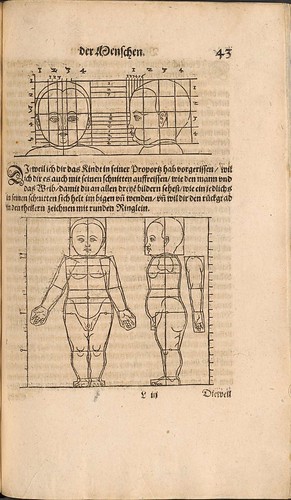
Heinrich Lautensack wrote a treatise on perpective,
Des Circkels und Richtscheyts, auch der Perspectiva und Proportion der Menscher, which owed much to Durer. The entire book can be viewed online at
Digitale Bibliothek - Munchen. Above figures in perspective and lines showing how to create orthographic front and side views of a child's figure.


John Everard published a series of books similar in some ways to
Edward Muybridge
's studies of motion. Everard used static figures on a rotating table and photographed them at intervals to show views of all sides. They serve as excellent references for the effects of foreshortening on the human body. These pictures are from
Second Sitting: Another Artist's Model
.
Here is another set from
Sculptor's Model
.
The Art Model Books follow a similar format.

Two images from the Art Models books, These wo are from the newest book Art Models 4 showing a foreshortened female figure in repose.


Two twentieth century foreshortened figure drawings by Harry Carmean.
Harry Carmean on Ebay

William Bouguereau,
The Bather, 1879, showing the use of perspective and foreshortening in drawing the legs.

Foreshortening is when an object or figure appears reduced in size when viewed from a particular angle. It is explained by the theory of perspective.
This image is from
An Introduction to Perspective Drawing and Painting by Mr. Hayter.
For more information about perspective:
How to Draw Perspective at Figure-Drawings.com.


 Atlas of Foreshortening: The Human Figure in Deep Perspective (Second Edition)
at Amazon.com

Foreshortened
Mary Magdalene by
Jules Joseph Lefebvre.
 Le Reveil de Diane
 by
Jules Joseph Lefebvre.

Foreshortened
Christ by
Andrea Mantegna.

The photograph is by Sam Haskins, it shows Gill, one of the models from his book
FIVE GIRLS
, you can read about it at his blog post
Conversation and at another post
The Age Of The Understatement about one of the photos being used on an album cover. Also check out one of the images from his book
November Girl
also at his blog, this post is titled:
Winter Blues.
African Image
another book by Sam Haskins. A new version is going to be published this year. One book still in print is:
Cowboy Kate and Other Stories: Director's Cut
.


For sale on Ebay are many figure water colors by
William Reginald Watkins. These show the use of foreshortening in rendering the limbs. William Reginald Watkins was born in Manchester, England and later studied at the Maryland Institute in Baltimore Maryland. There he studied under artists such as Hans Schuler, C.W. Turner and Maxwell Miller. He was a member of the Baltimore Watercolor Club, the London Royal Society of Art, Baltimore Art Director Club, National Art Director and the Maryland Institute Alumni Board. His work was exhibited both nationally and internationally. He was best know for landscapes, snowscenes, still life, portraits, and marine paintings. These are figure studies executed to keep up his craft.There is a listing at
Askart.com.
For more water color figure paintings by William Reginald Watkins see:
Water Color Figure Painting.


Series of foreshortened figure studies by John Singer Sargent.
 Joseph Mallord William Turner - Study of a Supine Male Nude Seen Foreshortened circa 1799-1805
.

Foreshortened figure at a
life drawing class in Birmingham, England.

Foreshortened figure by
John Peri.


Two foreshortened views of a model from
Evelyn Brandt's website.

Figure in perspective by German writer
Karl Heinrich Waggerl.

Perspective Photograph of a model by
Ronald Puhle.

Seated Foreshortening


A few more examples of the human body in perspective in foreshortened
figure drawings.

Watercolor perspective of nude by
Roger Hayward.
 Classic Human Anatomy: The Artist's Guide to Form, Function, and Movement


More drawings of foreshortened figures by
Charles Despiau.
Books related to Charles Despiau:
CHARLES DESPIAU Charles Despiau: Zeichnungen (German Edition)
 Despiau (Universe sculpture series)
 Chefs-D'oeuvres Des Collections Suisses De Manet a Picasso; Orangerie Des Tuileries, Paris 1967: L'Impressionisme; Cezanne, Gauguin Et Van Gogh; Les Nabis Et Les Pointillistes; Les Fauves; L'Ecole De Paris; Les Cubistes (Charles Despiau; Renoir; Degas)
 Rodin: The Shape of Genius
 André Salmon on French Modern Art
Female model foreshortening at
WetCanvas Forums.
Extreme foreshortening:
Veselinka Beba McLarnon's Blog post on figure drawing.

François-Léon Benouville - The Wrath of Achilles.
Frederic, Lord Leighton - life study.
Here is a another blog's post on Luis Ricardo Faléro's
Departure of the Witches showing lots of figures in various degrees of foreshortening.

Luis Ricardo Falero
Oriental

Luis Ricardo Falero
A Fairy Under Starry Skies
Falero's work reminds me of Jules-Joseph Lefebvre's. Here is a
site devoted to his work.

Jules-Joseph Lefebvre,
The Dream, an engraving after his painting "
Le Reveil de Diane," 1879.

Albert Arthur Allen Study of a figure showing foreshortening across the torso.
More Albert Arthur Allen figure studies.

Moise Kisling with a model, also see another post,
Moise Kisling - Nudes.

Roderic O'Conor, seated nude around 1925.

Roderic O'Conor, Nu Allonge, 1924.

Roderic O'Conor, Reclining Nude on a Chaise Lounge, 1915.
From Three Angles - Japanese Book about Foreshortening
Hyper Angle - Another Japanese Book about Foreshortening




 .
.


 , and from Cliff Young's


 ,
,  ,
,  ,
,  ,
,  ,
,  ,
,  ,
,  .
.