Showing posts with label human proportions. Show all posts

Saturday, July 2, 2011

The Proportions of the Human Figure by Joseph Bonomi

 Plates from the small book The Proportions of the Human Figure by Joseph Bonomi

PLATE III
The measures of Gibson's triangle are given on the staff of the central figure. They refer only to length.
The horizontal lines marked V are those supplied by Vitruvius; they show how much the figure has lost in height, by putting the whole weight of the body on one leg, or standing at ease.
The horizontal line marked G is that given by Gibson; it should be found to coincide with the dots.
The line at the left represents four cubits, one of which is divided into palms and digits.
The line on the right is divided into heads, parts and minutes.
N.B.—The leg on which a person stands is always some little less in width than that which bears no weight, owing to the contraction of the muscles for sustaining the limb in position for bearing the weight of the body; so is the measure from the pit of the neck to the shoulder, some little less on that side of the body. This will be seen by the tables.
PLATE IV.
Plate IV. shows the normal proportions of the female figure, and the measures correspond with those of Plate III.
Google books versions, you have to look at both of them to see all the plates.

The proportions of the human figure By Marcus Vitruvius Pollio, Joseph Bonomi

The proportions of the human figure By Joseph Bonomi

Here is a reference to the book in Human Proportions for Artists By Avard T. Fairbanks, Eugene F. Fairbanks.

Another mention of the book is found in Sculpture, Egyptian--Assyrian--Greek--Roman: With numerous illustrations, a map of ancient Greece and a chronological list of ancient sculptors and their works By George Redford

icon
icon
Human Proportions for ArtistsLeonardo Technical Manuals- Human Anatomy Plates for Artists
The Proportions Of The Human Figure, As Handed Down To Us By Vitruvius: From The Writings Of The Famous Sculptors And Painters Of Antiquity (1872)

Human Proportions for Artists

Leonardo Technical Manuals- Human Anatomy Plates for Artists

A related article published in 1879 relates other methods of determining proportion: The Measure of Man.


Anatomy: A Complete Guide for Artists


Anatomical Plates of the Bones and Muscles: Diminished from Albinus for the Use of Students in Anatomy and Artists (1807)

Anatomy Drawing School

Sunday, March 13, 2011

Proportions of the body examples of Hercules and Venus de Medici

This print about the relative proportions of the human body is from the Imperial Encyclopaedia or Dictionary of the Sciences and Arts Published by J. Robbins and Co., Paternoster-Row, London.

The print from the book is for sale on Ebay Click here to see them for sale on Ebay.


Hercules engraving from Raccolta di Statue Antiche e Moderne, Venus de Medici from a book published by J. Hagger.


From Scelta de più bei Monumenti della Scultura Antica, also for sale on Ebay, Venus is in the upper left.


An 1870 Lithograph which includes Hercules, also for sale on Ebay. The images include: Statue of the Throned Jupiter; Head of Jupiter of Otricoli; Ino-Leukothea with the Dionysos Child; Pallas of Vellatri; Diana of Versailles; Hercules Farnese; Head of Esculapius, from Melos; Horse-Tamer at Monte Cavallo; Eros and Psyche; Statue of Apoxyomenos; Statue of the Sleeping Ariadne; Centaur Borghese; The Grinder; Statue of the Resting Hermes; and Barberini Faun.

Saturday, March 5, 2011

Proportions of Faces

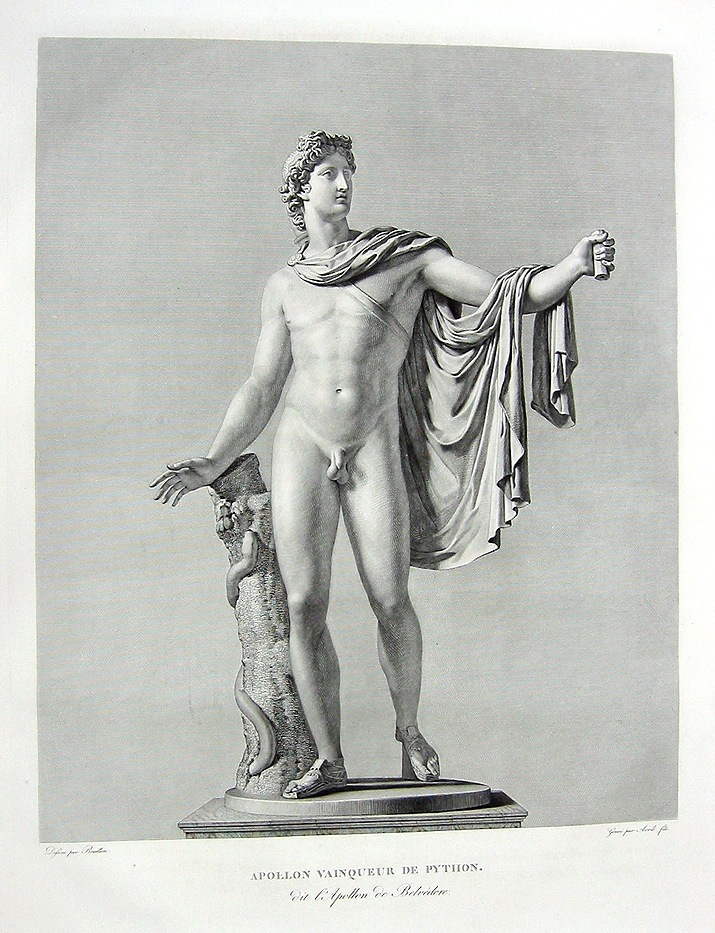
Gerard Audran's study of the proportions of the faces of the Apollo Belvidere and Venus de Melias. This version was published by Longman, Hurst, Rees, Orme and Brown, London.

From the book:Audran, in a work published in Paris, has given the following comparative scale of proportions of the faces of the Apollo Belvidere, and of an antique Venus, from adual measurement. Taking the length of the nose, which he calls a part (p), and dividing that in twelve parts, which he calls minutes (m), he dates the faces of the Apollo and of the Venus to have each three parts from the growth of the hair on the forehead to the bottom of the chin. Dividing the lower part into three, the uppermost gives the line of division of the lips ; the other parts are proportioned as follows:

Width of the face from ear to ear: Apollo: 2p 2m - Venus: 2p 2m
The eye, seen in front: 6m - 5 1/2m
Space between the eyes: 6m - 6m

Eye in profile, and the pupil in width: 2m - 2m
Width across the nostrils: 7 2/3m - 6 1/2m
Nose in profile: 6 1/2m - 6m
Width of mouth in front: 9m - 7 1/4m
same in profile: 4 1/2m - 3 2/3m

From the nostril to the ear, in profile: 1p 8 1/2m - 1p 6m
Length of the ear: 1p - 1p

The plate from the book is for sale on Ebay Click here to see them for sale on Ebay.


P. Bouillon's engravings of the Apollo Belvedere and Venus de Milos.

Gerard Audran's The Proportions of the Human BodyFrancois Duquesnoy and the Greek Ideal
Gerard Audran's The Proportions of the Human Body
Francois Duquesnoy and the Greek Ideal


A Caricaturist's Handbook: How to Draw Caricatures and Master Exaggeration

Saturday, February 5, 2011

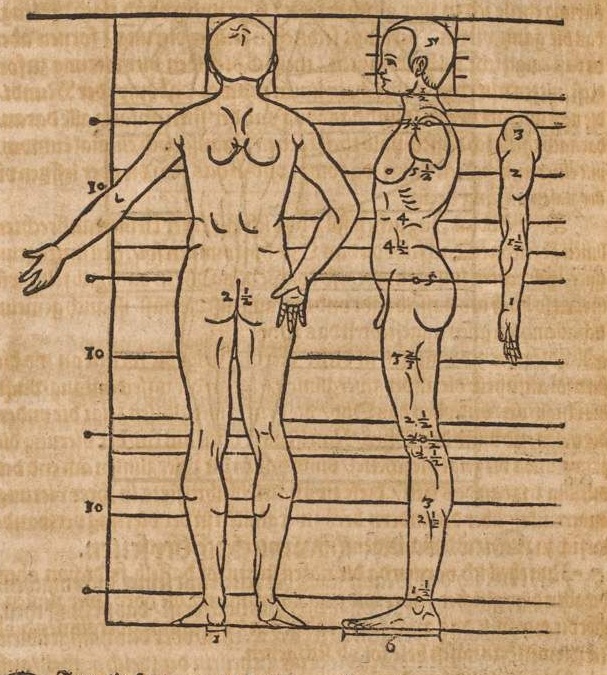
Heinrich Lautensack -Male and Female Proportions

 Front view - male skeleton, male figure and proportional mass drawing of a man,
Side view - male skeleton, male figure and proportional mass drawing of a man


Heinrich Lautensack wrote a treatise on perpective,  Des Circkels und Richtscheyts, auch der Perspectiva und Proportion der Menscher, which owed much to Durer. The entire book can be viewed online at Digitale Bibliothek - Munchen.

Proportions of the female body, front and side views, back and side views.

Proportions of the male body, front and side views, back and side views.

 The female body divided into eight parts, the male body divided into eight parts.


The following information is from The Dictionary of painters and engravers, biographical and critical By Michael Bryan

LAUTENSACK, Henry, [or Heinrich.] This old German engraver is miscalled, by Mr. Strutt, Hans, or John. He was born at Nuremberg about the year 1506, and was the son of Paulus Lautensack, an obscure painter, who taught him the rudiments of design. He engraved some plates in the style of Sebald Beham, though very inferior to him. He usually marked his prints with a cipher composed of the initials H. L. on a tablet, with an instrument resembling a graver, and the date.
He is said to have engraved on wood. [With regard to this artist, real or supposed, the inquirer should consult Bartsch, Brulliot, Nagler, and others that they indicate, as there is much obscurity about him and his works. Some think that Heinrich and Hans are one. Zani says he died about 1590. The word leytzen is inscribed on some of the prints attributed to him: this is a subject for German etymologists.]

The History and Bibliography of Anatomic Illustration in its Relation to Anatomic Science and the Graphic Arts By Ludwig Choulant, Mortimer Frank, Fielding Hudson Garrison, Edward Clark Street has this to say about Heinrich Lautensack:
Heinrich Lautensack: Desz Circkelsz vnd Richtscheyts, auch der Perspectina, vnd Proportion der Menschen vnd Rosse, kurtze, doch griindtliche vnderweisung, desz rechten gebrauchs. Mit viel schonen Figuren, aller anfahenden Jugendt, vnnd andern liebhabern dieser Kunst, als Goldschmiden, Malern, Bildhauwern, Steinmetzen, Schreinern, etc. eigentiich furgebildet, vormals im Truck nie gesehen, sonder jetzunders von neuvxn an tag gegeben, Durch etc. Gedruckt zu Frankfurt am Mayn bey Egenolff Emmel, Jn verlegung Simonis Schambergers. Jm Jahr, M.D.C.XVIII, colophon: Gedruckt zu Franckfurt am Mayn, Jm Jahr 1618, folio.
Contains 4 and 54 pages with many woodcuts printed in the text; the third part of the book dealing with the proportions begins on page 326 and contains many woodcuts, which, however, are smaller than Diirer's. On page 51a the text on the proportions of the bodies of horses begins, illustrated by three woodcuts. It has been published_before at Frankfort on the Main by G. Rabe, S. Feyerabend, and H. Lautensack, in 1564. folio. Weigel: No. 8545, 19427. The author, on the title-page, calls himself a goldsmith and painter of Frankfort on the Main.

Albrecht Durer: Vier Bücher von menschlicher Proportion some of the plates at the NIH website.

The Art Student's Guide To The Proportions Of The Human FormGerard Audran's The Proportions of the Human BodyAlbrecht Durer (1471-1528) On Human Proportion