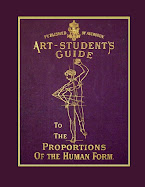
A new book,
Anatomy for Art Students, Painters and Sculptors, is available both as an ebook at
Figure-Drawings.com and as a printed book at
Lulu.com, and at
Amazon.com

This is a republished edition of
The Anatomy of the External Forms of Man, Intended for the Use of Artists, Painters and Sculptors by Doctor J. Fau, Lithographed by M. Leveillé, pupil of M. Jacob, New edition with additional plates by William Norris. I located another edition with a publication date of 1849.
Another edition featuring the black and white engravings was just published on June22, 2009 and is available at Amazon.com:

 Human Anatomy for Artists: A New Edition of the 1849 Classic with CD-ROM (Dover Pictorial Archives)
The following information about Dr. Fau, the editor of the book is from Ludwig Choulant's
History and Bibliography of Anatomic Illustration, published in 1920.
JULIEN FAU
Julien Fau, doctor of medicine in Paris, edited two different anatomic works for artists: Anatomie des formes exterieures du corps humain, a I'usage des peintres et des sculpteurs. Avec un Atlas de 24 planches dessinées d'apres nature et lithographiees par M. Leveille, eleve de M. Jacob. Paris: Mequignon- Marvis fils, 1845 (16 and 214 pp.), 8° and fol. (24 lithographic plates), black and white and also colored.
 The plates are very beautifully finished and comprise one plate of skulls of different nationalities; several different views of the nude bodies of a man, a woman, and a child, all drawn from nature, some of them supplemented by skeletons placed alongside of the bodies, with the body outlines; representations of the bones, and the muscles, the latter with the bones in some cases drawn in.
Particular attention has been given to the various positions and flexions of the extremities. The last plate represents the myology of the Laocoon, without the sons, after Charles Clement Bervic's well-known print. This work has been translated into English, with additions, by the physician Robert Knox, and published under the title: The anatomy of the external forms of man, intended for the use of artists, painters and sculptors, London, 1848, 8°, with an atlas of 26 plates in quarto; published in black and white and also colored.
 The second, smaller, and less expensive work by Fau is: Anatomie artistique elementaire. Dessins d'apres nature par J. B. Leveille, gravures sur acier. Paris: Mequignon-Marvis, 1850, 8°, with 17 steel engravings in 8°, three of which are in small folio.In this work the representation of the shapes of skulls, of the nude bodies, and of the Laocoon are missing, but representations of three beautiful skeletons, with the contours drawn around them, have been added. The remainder deals with osteology and myology, although less exhaustively than in the previous work.
The same author had a young artist, Eugene Caudron, a pupil of David d'Angers, make an anatomic plaster statuette, 70 centimeters high, for the use of artists (nouvel ecorche) which is sold, white or colored, with a description and four pages of pictorial representations (the four views of the statuette), for 15 and 30 francs respectively (the description alone costs 3 francs). Prior to this, Johann Martin Fischer's plaster.
The second, smaller, and less expensive work by Fau is: Anatomie artistique elementaire. Dessins d'apres nature par J. B. Leveille, gravures sur acier. Paris: Mequignon-Marvis, 1850, 8°, with 17 steel engravings in 8°, three of which are in small folio.In this work the representation of the shapes of skulls, of the nude bodies, and of the Laocoon are missing, but representations of three beautiful skeletons, with the contours drawn around them, have been added. The remainder deals with osteology and myology, although less exhaustively than in the previous work.
The same author had a young artist, Eugene Caudron, a pupil of David d'Angers, make an anatomic plaster statuette, 70 centimeters high, for the use of artists (nouvel ecorche) which is sold, white or colored, with a description and four pages of pictorial representations (the four views of the statuette), for 15 and 30 francs respectively (the description alone costs 3 francs). Prior to this, Johann Martin Fischer's plaster.

 Photos are of two different sculptures by Jacques-Eugène Caudron each titled Écorché (dissection of a man).
The second is in Rouen ; musée Flaubert & d'Histoire de la Médecine. It was a clever piece, according to a description at the French Ministry of Culture, which has a great searchable website of French art objects, "Each arm is removable by Keys. The chest and abdominal wall are open and reveal the organs dealt with summarily. "
A modern version on the
Écorché is available.
The Male Anatomy Figure : version 1 from Cawrse Authentic Anatomical Figures is for sale as are other detailed anatomical models.
There were as many as ten editions of the book published in French, English, Dutch and German. The
Anatomie artistique elementaire (
Petit Fau) has shortened descriptions and only 17 steel engraved plates. I have come across an English version of it with additional illustrations and notes on sculpting, muscular anatomy and human proportion. I am working on an ebook version of this. Below are 3 photos of the French Edition from 1865. This was a self published book by Jonathon Scott Hartley which contains the same steel black ink engravings as
Anatomie artistique elementaire . Hartley's book combines the plates with extensive commentary on anatomy and a chapter on proportion and the art of modeling (sculpting in clay).
Another English edition with plates was
Elementary Artistic Anatomy of the Human Body, Translated and edited by Charles Carter Blake was published in 1881. There is a reference to Carter Blake in
Charles Darwin's letters, Blake was an advocate of the discredited study of cranioscopy, which tried to make sense out of the races by a study of skulls. There was a schism in Victorian science with some arguing that cranioscopy proved distinct races, and ethnologists arguing for the unity of the races.
Preceeding Dr. Fau's book and perhaps influencing it was another by P.N. Gerdy similarly titled
Anatomie des Formes Exterieures which included 3 schematic diagrams of the human form.
Another book with art designed by M. Leveille and engraved under his supervision was
Heath's Operative Surgery.
A Course of Operative Surgery, consisting of a Series of Colored Plates, each plate containing Several Figures, Drawn from Nature by the Celebrated Anatomical Artist, M. Leveille, of Paris, Engraved on Steel under his immediate superintendence, with Descriptive Text of Each Operation, and numerous Wood Engravings. By Christopher Heath, F.r.c.s., Surgeon to University College Hospital, and Holme Professor of Clinical Surgery in University College, London. One Large Quarto Volume. Second Edition, Revised and Enlarged. Sold by Subscription. Full information upon application. Cloth, $12.00. P. BLAKISTON, SON & CO., 1012 Walnut St., Philadelphia.


A German edition of Dr. Fau's book was published by Anton Elfinger (January 15, 1821 - January 19, 1864). His book titled
Anatomie des Menschen die Knochen - Muskel - und Bandelehre was published in 1854. It has 27 lithographs of which three are original designs by Elfinger and are plates of skulls. One of these appears in
The Anatomy of the External Forms of Man, Intended for the Use of Artists, Painters and Sculptors which is the basis for my republished edition. I found another and included it is the introduction. Anton Elfinger was a physician in Austria. He studied at the Academy of Fine Arts in Vienna under Leopold Kupelwieser and after his studies there took up the study of medicine, less by choice than at the urging of his family, earned his doctorate in 1845.
Anatomie des Menschen, die Knochen-Muskel- und Bänderlehre enthaltend in 27 lithografirten Tafeln. Bevorwortet und erklärt von Dr. Anton Elfinger
He became a permanent employee of the Vienna General Theaters newspaper and contributed costume pictures which he signed "Cajetan." He also contributed illustrations to Humoristisch-Satiriscen Volkskalender and was a cartoonist and political cartoonist.
A concert in 1846 by Cajetan from
larousse.fr.

He worked with a dermatologist, Ferdinand von Hebra and was an illustrator of medical literature. He produced the watercolors for Hebra's Atlas der Hautkrankheiten (Atlas of Skin Diseases). Another book he illustrated is Horizontaler Durchschnitt des Menschlichen Auges, by Dr. Arlt. This book illustrates the human eye.
F. von Hebra informational website with images taken from Anton Elfinger's lithographs for Hebra's book.
Wikipedia article.
Skin in Water-Colours: Unpublished Aquarelles from Hebra's Department in Vienna 1841-1843
at Amazon.com.
The last three plates in the book are dissections of ancient statuary, The Laocoon, The Gladiator and Discobolus. Link to Washington School of Medicine -
Monuments of Medicine page - rare books from the Bernard Becker Medical Library, which has a note on the French edition and a picture of the Laocoon Plate, compare it to the original sculpture. The Laocoon plate was original to the French edition, the Gladiator and Discobolus are original to theEnglish edition.

 Anatomie Des Formes Exterieures Du Corps Humain
at Amazon.com.
A Manual of Artistic Anatomy for the Use of Students in Art
at Amazon.com.
Dramatic photos of the
Laocoon group.

The final section of the book contains 12 pages of hand drawn ink drawings of bone and muscle by an unknown artist. These provide very clear illustrations of the structure of the human body, and have extensive clear labeling.
A link to an exhibition of
Jean Baptiste François Leveillé's works and
another one and a link to the home page of the exhibition
Anatomy Acts. Google Books result for
Traite Practique D'Anatomie, with plates by Leveillé.


According to Boris Röhrl in his
History and Bibliography of Artistic Anatomy, Julien Fau's textbook along with Duval's
Precis d' Anatomie, were the most successful publications of their period. Fau's invention was to supplement the textbook with the large atlas of prints. Röhrl also notes that for the reader not interested in the extensive description of the prints found in the textbook a pocket book,
Anatomie artistique elementaire, was created. French at students called the small volume
Petit Fau, and the large textbook
Grand Fau. Röhrl argues that while Fau was influential in anatomical studies, his main concern was with the faithful rendering to produce art.
"The only question posed is why a picture executed with the greatest scientific exactitude should not be an effective work of art at the same time.Thoughts based in the metaphysical or spiritual sphere were not considered by Fau, but he does recognize that the plain reproduction of nature did not produce artistic value in a certain work to the same degree. His main argument lies in a continuation of the tradition of the Renaissance."
You can search for a copy of Röhrl's book at
Abebooks.com. Use the search terms "
Boris Röhrl," or "
History and Bibliography of Artistic Anatomy."


An English translation of the large textbook (
Grand Fau) without the plates is at Google Books
The Anatomy of the External Forms of Man, ed. with additions by R. Knox.
A reprint of the atlas of anatomical prints is what makes up my book,
Anatomy for Art Students, Painters and Sculptors.
Links:
Bibliothèque artistique de la Ville de Bruxelles - Art Library of the City of Brussels - Image from
Anatomie des formes exterieures du corps humain.
These arrangements were informal, but then “anatomical modeller” was not a regular occupation. Medical models were made by artists, preparators and others. Most German universities had a drawing teacher, but professors’ attempts to create posts for scientific artists tended to founder on the combination of demanding job description and low academic and artistic status. Models were more of a luxury than drawings and the skill was less widely distributed. Some state collections already employed staff to prepare specimens for display—Munich's zoological preparator had a doctorate—but it was rare for a medical modeller to gain a dedicated position, such as Joseph Towne enjoyed at Guy's. In Vienna Dr Anton Elfinger was from 1849 hired by the medical faculty to produce illustrations and models, but the money soon ran out. A little later at the University of Freiburg in Baden Dr Adolf Ziegler made embryological waxes as a zootomical Assistent, a position that for others was a stepping-stone to a chair, but from which he resigned in 1868 to build up a private studio.
Related Books:
Art of Drawing Anatomy
 The Artist's Guide to Human Anatomy
 The Female Nude I: A Pose Book For Artists
 The Nude Female Figure: A Visual Reference for the Artist
 Art Models 4: Life Nude Photos for the Visual Arts (Art Models series)
 Art Models 3: Life Nude Photos for the Visual Arts (Art Models series) (No. 3)
 Art Models 2: Life Nude Photos for the Visual Arts (Book & CD-ROM) (No. 2)
 Art Models: Life Nudes for Drawing Painting and Sculpting
Samples from the art models books.


 Classic Human Anatomy: The Artist's Guide to Form, Function, and Movement
A post about Japanese Artist
Kuwagata Keisai (Kitao Masayoshi) shows examples of his figures and a drawing of human proportions.
Artist versus Anatomist, Models against Dissection: Paul Zeiller of Munich and the Revolution of 1848 "
...These arrangements were informal, but then “anatomical modeller” was not a regular occupation. Medical models were made by artists, preparators and others. Most German universities had a drawing teacher, but professors’ attempts to create posts for scientific artists tended to founder on the combination of demanding job description and low academic and artistic status.39 Models were more of a luxury than drawings and the skill was less widely distributed. Some state collections already employed staff to prepare specimens for display—Munich's zoological preparator had a doctorate—but it was rare for a medical modeller to gain a dedicated position, such as Joseph Towne enjoyed at Guy's. In Vienna Dr Anton Elfinger was from 1849 hired by the medical faculty to produce illustrations and models, but the money soon ran out. A little later at the University of Freiburg in Baden Dr Adolf Ziegler made embryological waxes as a zootomical Assistent, a position that for others was a stepping-stone to a chair, but from which he resigned in 1868 to build up a private studio..."
Other Books:
Anton Elfinger
Elfinger, Anton u. Ferdinand Hauser
Der physische Mensch. Wissenschaftlich-populäre Zusammenstellung des Wichtigsten über den Bau des menschl. Körpers und seine Lebensverrichtungen.
 Anatomy for Artists: A Complete Guide to Drawing the Human Body
 Female Anatomy Figure: Version 1
 Female Anatomy Figure: Artist Version 2C
Video of the female ecorche.

 - The dawn of life


 Or download a copy at


 .
.