
Erheit den ersten Schoenheitspreis auf dem Ball der Quat-z-'arts in Paris
im Januar 1906. Farbige franzosische Radierung nach der Natur von Henry
Detouche.
The Award Winner
Exhilarating beauty of the first prize winner of the Bal de Quat-z-'arts in Paris
in January 1906. French colored etching from nature by Henry
Detouche.
The Ball was an annual event of the Ecole Nationale des Beaux-Arts in Paris. It originated in 1892 in Montmartre.
Print on Ebay.
BAL DES QUAT'Z' ARTS from The Real Latin Quarter By Frank Berkeley Smith:

 The first "Quat'z' Arts" ball was given in 1892. It was a primitive affair, compared with the later ones, but it was a success, and immediately the "Quat'z' Arts" Ball was put into the hands of clever organizers, and became a studied event in all its artistic sense. Months are spent in the creation of spectacles and in the costuming of students and models. Prizes are given for the most successful organizations, and a jury composed of painters and sculptors passes upon your
  costume as you enter the ball, and if you do not come up to their artistic standard
  you are unceremoniously turned away. Students who have been successful in getting into the "Quat'z' Arts" for years often fail to pass into this bewildering display of beauty and brains, owing to their costume not possessing enough artistic originality or merit to pass the jury.
 It is, of course, a difficult matter for one who is not an enrolled member of one of the great ateliers of painting, architecture, or sculpture to get into the "Quat'z' Arts," and even after one's ticket is assured, you may fail to pass the jury.
Imagine this ball, with its procession of moving tableaux. A huge float comes along, depicting the stone age and the primitive man, every detail carefully studied from the museums. Another represents the last day of Babylon. One sees a nude captive, her golden hair and white flesh in contrast with the black velvet litter on which she is bound, being carried by a dozen stalwart blackamoors, followed by camels bearing nude slaves and the spoils of a captured city.
The Real Latin Quarter (Illustrated Edition)

The Art of Posing Nude: Models, Moralists, and the 1893 Bal des Quat'z-Arts - Lela Felter-Kerley

Figures du corps : Une leçon d'anatomie à l'école des Beaux-Arts

A catalog of the models, plaster casts, skeletons, tools and photographs used at l"Ecole des Beaux Arts.
Artist quarter;: Reminiscences of Montmartre and Montparnasse in the first two decades of the twentieth century

The last Bohemia,: From Montmartre to the Quartier latin,
A fictional treatment is at The Birth of Aphrodite by Louise E. Taber, The Overland Monthly, 1915.
Another description is at Bohemian Paris of Today by William Chambers Morrow, Edouard Cucuel.
A review of the book from Public opinion, Volume 27 By Progressive Conservative Party of Canada


Bohemian Paris of to-Day. Written ... From Notes by E. Cucuel. Illustrated by E. Cucuel.

BOHEMIAN PARIS OF TO-DAY

This description is from Diary of an American Art Student in Paris
Showing How She Succeeded in Going to the Louvre Every Day by Nancy Boyd Vanity Fair 1922
 |
|
GUSTAVE ASSIRE
Le défilé du bal des Quat'Z'Arts, 1926
|
Almost time for classes to begin, and I've not even been to the Louvre yet. I can't believe it.
But I've had enough of this. I'm through.
American Hospital, Neuilly. Friday Afternoon
I'VE got to write a little or go crazy.
 |
| Préparatifs pour le bal des Quat'z-Arts Gordon Coutts, 1913 |
And that beautiful costume Nina lent me—I wonder where it is—I think I remember dimly—oh, if I could only die!
Invitations are visible at Affiches et cartes d'invitation au Bal de l'Internat des Hopitaux de Paris 1897-2003
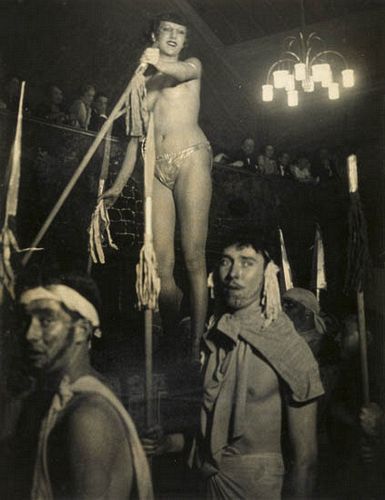 |
| Brassaï Le Bal des Quat'z Arts, Paris |
Webpage about Le Bal des Quat'z'Arts
 |
Brassaï
Le Bal des Quat'z Arts, Paris
|
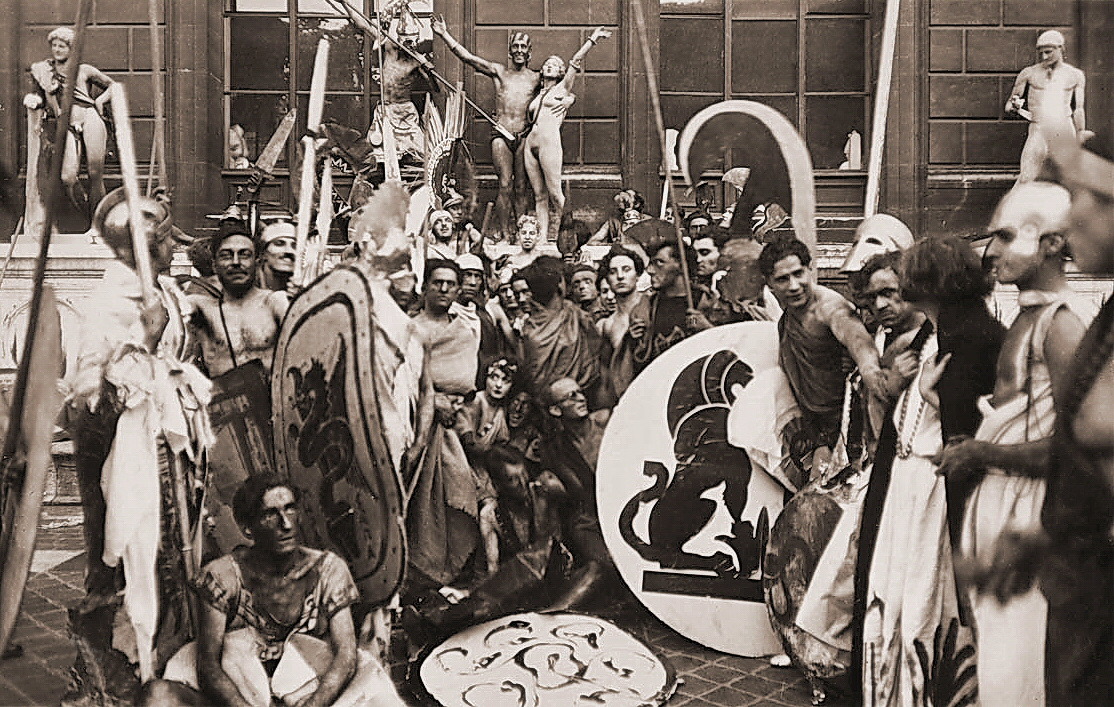
BAL DES QUAT'Z' ARTS - FROM NOTES OF EDOUARD CUCUEL - BY W. C. MORROW
Author of " A Man: His Mark," " The Ape, The Idiot, and Other People" For a Forthcoming Volume entitled " Bohemian Paris of To-Day", Lippincott's monthly magazine, Volume 64, 1899
As the Bal des Quat'z' Arts is not open to the public, and as none but accredited members of the four arts are admitted, the greatest precautions are taken to prevent the intrusion of outsiders; and wonderful is the ingenuity exercised to outwit the authorities. Inside the vestibule of the Moulin was erected a tribune (a long bar), behind which sat the massiers of the different studios of Paris, all in striking costumes. It was their task not only to identify the holders of tickets, but also to pass on the suitability of the costumes of such as were otherwise eligible to admittance. The costumes must all have conspicuous merit and be thoroughly artistic. Nothing black, no dominoes, none in civilian dress, may pass. Many and loud were the protestations that rang through the vestibule as one after another was turned back and firmly conducted to the door.
Once past the implacable tribunes, we entered a dazzling fairy-land, a dream of rich color and reckless abandon. From gorgeous kings and queens to wild savages, all were there; courtiers in silk, naked gladiators, nymphs with paint for clothing,—all were there; and the air was heavy with the perfume of roses. Shouts, laughter, the silvery clinking of glasses, a whirling mass of life and color, a bewildering kaleidoscope, a maze of tangled visions in the soft yellow haze that filled the vast hall. There was no thought of the hardness and sordidness of life, no dream of the morrow. It was a wonderful witchery that sat upon every soul there.

 My Parisian year; a woman's point of view
 There are several student-balls in Paris—Art students, bien entendu. The most celebrated of these is the Bal des Quat'z Arts, given every year in some huge arena. Each year the authorities select a certain period of ancient history for the costumes, and they are very particular indeed. The dress has to be exact down to the smallest item, or the wearer is not permitted to enter. I know one man who was turned away because his sandals were not of the period. Another man had to remove and hide his eyeglass before he entered. Also very great care is shown that no outsiders should penetrate the mystic portals: nevertheless it can be done. I know several people who have been, but they have to be well posted in their answers to the doorkeepers—they must say the school they belong to, and be prepared to answer any other questions.
Of course it is a most marvellous sight, this ball, a kaleidoscope of moving colour.
The models are there in force, many of them not in costume. There is a procession during the evening with banners, some of these grossly indecent, but designed by some famous artist. The cards are also works of art in their way—a way which would make the uninitiated Anglo-Saxon open his eyes in surprise. Alas! so would some of the " goings on " at the ball! Art students at play are not renowned for what we are used to considering refinement. The models of course take an important place in these orgies, and, as the night wears away, an outsider suddenly thrust into the ballroom would rub his eyes, and think his body had been, in some mysterious way, transported back to the ancient Roman or Greek days.


 at Amazon.com.


 's work departs from the rules of the academy. He collected photos and nude pictures of models. His women have a contemporary expression. Rodin, who said that nature is his teacher, also works from photographs. His contemporaries did not understand his realistic approach, and his sculptures provoke more than once a scandal - not so much because they are naked, but because they do not conform to the aesthetic ideal.
 and Rodin have definitely changed the look at the nude, the old rules of the ideal of classic beauty will remain in effect for a long time at the Show. The academies, however, allow the late nineteenth century gradually photography as auxiliary and are even collections.
 ,
,  ,
,  , nine major
  nudes, several sculptures by Rodin and many historic photographs from the collection of the
  in Paris.




 .
.


